Picture a bank in 1930s America. Word gets around that the bank might be in trouble. There's no proof — just a rumour, maybe a whisper from someone who heard something. People start lining up outside. As the line grows, more people notice and join it. By afternoon, the bank runs out of cash — not because it was actually broken, but because everyone tried to leave at the same time.
This exact thing happened to a DeFi stablecoin in May 2022. The protocol had the money. The math was clean. The collateral was real. And it still failed.
That's what makes Angle Protocol worth studying. It didn't fail the way most DeFi collapses do — through a hack or a bad bet. It failed the way banks fail: through a coordination breakdown among people who were all individually making rational decisions.
First, what even is a stablecoin?
A stablecoin is a crypto token designed to always be worth $1 (or €1, or whatever peg it targets). The challenge is that crypto is insanely volatile, and you're trying to build a stable thing on top of unstable collateral.
Think of it like a dollar-pegged note backed by gold — except the gold price swings 10% a day. How do you keep the note worth exactly $1?
There are a few common approaches. Some stablecoins just hold real dollars in a bank (USDC, USDT). Simple but centralised — you're trusting a company. Some use overcollateralisation — you lock up 100 of stablecoins. Safe but capital-inefficient. And then there's the clever approach: delta-neutral design. This is what Angle used.
What does "delta-neutral" actually mean?
Let's start with a real-world analogy before the DeFi version.
Airlines hate oil price risk. When oil goes up, their costs spike. So they hedge: they buy futures contracts that go up in value when oil rises. Now if oil rises, they lose money on fuel costs but make money on the futures. If oil falls, they pay less for fuel but lose on the futures. The two bets cancel each other out. Their net exposure to oil price changes is roughly zero. That's delta-neutral — you've set up two opposing positions that cancel out price risk.
Angle did the same thing with ETH. When you deposited ETH into Angle and received agEUR (their euro stablecoin), Angle immediately set up a short position on ETH futures to cancel out the price risk of your ETH. So even if ETH crashed 50%, Angle's net position didn't move much. The protocol always held approximately the right amount to back the stablecoins it had issued.
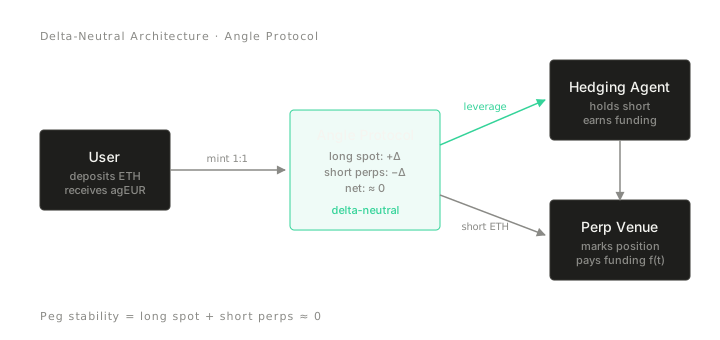
In math form, the idea is simple: if you hold a long position (owning ETH) and a short position (futures betting ETH goes down) of equal size, your total price sensitivity is zero:
Who are the hedging agents, and why do they matter?
Angle didn't hold the short positions itself. It brought in external traders called hedging agents (HAs) to do it.
Here's the deal it offered them: if you come in and hold a short on ETH futures, you get to earn the funding rate (a fee paid between traders in futures markets) plus leveraged exposure to ETH's upside. In bull markets, when everyone wants to go long on ETH, funding rates are positive and HAs got paid well to hold their shorts. It was a good deal.
In terms of what they earned over time, the formula looks like this:
This is elegant. Angle gets its hedge for free (HAs want it). HAs get yield and leverage. Users get a stablecoin with no liquidation risk. Everyone wins... as long as conditions stay reasonable.
The crack in the design: HAs could leave whenever they wanted
Here's the thing nobody talked about enough: Angle's hedging agents were not locked in. They could redeem their positions and leave at any time.
In normal times, this doesn't matter. Why would anyone leave a position that's paying them?
But in a crash — specifically, when ETH is falling fast and funding rates have gone negative (meaning shorts now have to pay instead of receive) — staying in the position starts costing money. At that point, every HA faces a simple question every few seconds: stay and keep paying, or exit and stop the bleeding?
Formally, each hedging agent at every moment is choosing between two options:
If you stay, your value is the stream of future funding payments — which might be negative:
If you exit, you get your capital back immediately, minus some slippage:
When funding is negative and you expect it to stay negative, exiting wins. Simple math. Each individual HA making this calculation is completely rational.
The problem is what happens when they all make this rational calculation at the same time.
The bank run logic: why being second is catastrophic
Back to our 1930s bank. Let's say the bank has 10 notes. If you're the first person to withdraw, you definitely get your $10. If you're the last person to withdraw, there might be nothing left.
This creates a brutal game: it doesn't matter whether the bank is actually broken. If you think enough other people will run, you should run too — to make sure you're near the front of the line, not the back.
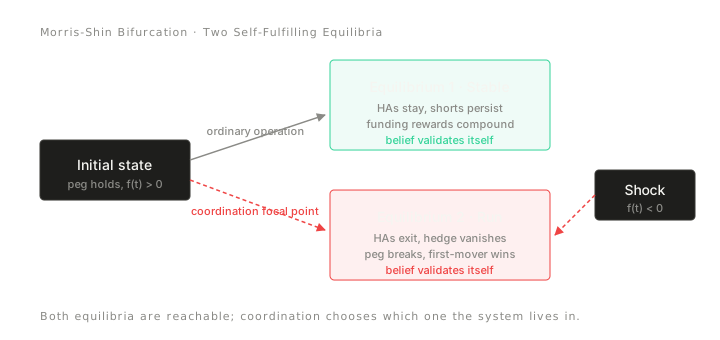
Douglas Diamond and Philip Dybvig formalised this in 1983 in one of the most cited economics papers of all time. Their paper, 'Bank Runs, Deposit Insurance, and Liquidity' (Journal of Political Economy, Vol. 91, No. 3, 1983, pp. 401-419) proves that suspension of convertibility is the minimal intervention needed to eliminate the run equilibrium - not as a heuristic, but as a formal game-theoretic result. Their insight: bank runs don't need a real problem to start. They can be entirely self-fulfilling. If people believe a run will happen, it will happen. The belief creates the reality.
Angle's hedging agents were in exactly this position. Exit queue position mattered. First to leave got full value. Last to leave got whatever remained after everyone else had left.
So the question each HA faced wasn't just "should I leave?" — it was "am I about to be left behind?" The moment you thought someone else was running, you had reason to run too:
Why uncertainty made it worse: the information problem
There's one more layer to this. In Angle's design, the exact health of the protocol — how much reserve it had, how exposed it was — wasn't perfectly visible on-chain in real time. HAs had to infer it from indirect signals: funding rate movements, liquidation activity, what they could see other large players doing.
Two economists, Stephen Morris and Hyun Song Shin, studied exactly this kind of situation in 1998. Their paper 'Unique Equilibrium in a Model of Self-Fulfilling Currency Attacks' (American Economic Review, Vol. 88, No. 3, 1998, pp. 587-597) shows that with noisy private signals, the multiple-equilibria indeterminacy of Diamond-Dybvig collapses to a unique threshold equilibrium - meaning runs become predictable and inevitable once a specific reserve level is crossed, rather than random. Their finding: when people are trying to read each other's beliefs from noisy signals, even small disagreements about what's happening can tip the whole system into a run. You don't need bad news. You need ambiguous news and smart, rational players who know everyone else is watching the same ambiguous news.
In Angle's case: each HA saw their own version of the situation. Some saw funding go negative and calculated the math. Some saw a large whale reduce their position. Some saw both and drew conclusions. Small variations in interpretation led to divergent responses — and once the first wave of exits started, that was the signal everyone else needed.
What actually happened in May 2022
In May 2022, the broader crypto market was falling hard. ETH dropped roughly 70% over six weeks — one of the fastest collapses in its history. The funding environment flipped: rates that had been positive and rewarding to HAs turned negative. Holding a short position now cost money instead of paying it.
Around May 9, 2022, a few large hedging agents started trimming their positions. They weren't doing anything unusual — just managing risk rationally. But to every other HA watching the market, this was a signal: sophisticated players are getting out.
That signal triggered a cascade. More HAs exited. Which triggered more. Which triggered more. Within days, the majority of hedging agent capital had been redeemed from Angle.
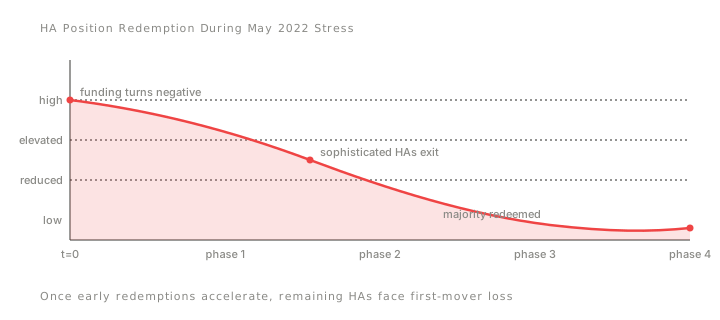
Without hedging agents, the delta-neutral mechanism collapsed. Angle's collateral was no longer hedged. The protocol was long ETH in a crashing market with no short to offset it. agEUR lost its peg.
And here's the thing that makes this remarkable: the protocol was solvent the whole time. It had real assets backing the stablecoins it had issued. In the formal sense:
That ratio stayed positive throughout. But the peg still broke, because:
And that one became false the moment the hedges evaporated. Solvent but unstable is the exact failure mode Diamond and Dybvig described. Angle ran it live.
The fix that would have worked: just add a waiting period
Here's the frustrating part. The fix is almost offensively simple.
If Angle had required hedging agents to wait, say, 7 days before their redemption went through, the bank run logic completely breaks down. Let's think through why.
In the run scenario, the reason to leave early is that you're scared of being last. Early = full value, late = discounted or zero. The entire incentive to run is about queue position.
But if everyone has to wait 7 days anyway, there's no queue advantage. You can't jump the line. Being first to request redemption doesn't get you anything. And by the time 7 days pass, the market panic might have settled — meaning the slippage that scared you hasn't materialised:
Diamond and Dybvig called this "suspension of convertibility" — temporarily halting withdrawals. They proved in 1983 that this is the minimal intervention needed to stop a self-fulfilling run. Banks have used it in crises. DeFi largely hasn't built it in.
Angle had zero mechanism to enforce a waiting period. HAs could exit in the same block they decided to. The first-mover advantage was fully intact.
Why this matters beyond Angle
The really unsettling thing about this story is that Angle's math was right. The delta-neutral mechanism was correctly designed. If the hedges had held, the peg would have held, regardless of how far ETH fell. The failure wasn't in the equations — it was in the incentives that surrounded them.
And that distinction matters because right now, in 2026, there are protocols managing billions of dollars using structurally similar designs. The same question applies to each of them: if conditions turn bad enough, and smart players all start doing the rational thing simultaneously, does the system have anything that breaks the run dynamic?
Getting the math right is necessary but not sufficient. The incentives around the math determine whether the system survives the moment when everyone's rational interests stop pointing in the same direction.
Angle proved this in the most expensive way possible. The next question is which protocol is next in line to prove it again.