If you've been paying attention to DeFi in the past year, you've probably seen USDe. It's a stablecoin that pays yield — sometimes 20%, sometimes 30%, occasionally higher — without you having to do anything complicated. Just hold it and earn. It's grown to billions in TVL because that pitch is genuinely compelling.
The yield is real. The protocol is well-built. The team is serious.
There's also a number buried in the docs that doesn't get discussed much: 1.7%. That's the reserve ratio — the cushion between everything going fine and the system running out of money. For every 100 of USDe issued, Ethena has {{red:1.70}} set aside as insurance.
Rather than dropping a single number, we'll estimate the reserve floor step by step using Cramér-Lundberg ruin theory, target a 1% ruin probability, and show how the answer changes across assumptions.
How USDe actually makes money
Before we can understand the risk, you need to understand the business model. It's clever, but it has a specific weak spot.
When you mint USDe, Ethena takes your ETH (or another asset) and does two things simultaneously. First, it stakes the ETH to earn staking rewards — currently around 4% a year. Second, it opens a short position on ETH futures to cancel out the price risk (the same delta-neutral logic we covered in the Angle piece — if you haven't read that, the short version is: owning ETH and shorting ETH futures at the same size means you don't care if ETH goes up or down).
But opening a short position on perpetual futures doesn't just neutralise risk — it also generates income. In crypto markets, when more people want to bet that ETH goes up (which is most of the time), traders who are willing to bet the other way get paid a fee. That fee is called the funding rate, and in bull markets it can be enormous — 15%, 20% APR and higher.
So USDe's income equation looks like this:
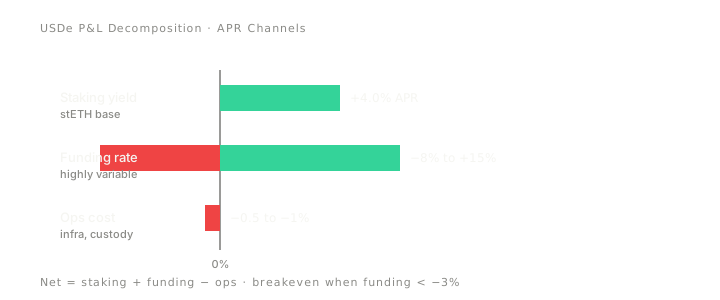
When the funding rate is high — say 15% — the protocol makes 4% + 15% - 1% = 18% net, which it passes on to USDe holders as yield. That's where the big APYs come from.
When funding goes negative — when the market turns bearish and more people want to short than long — the equation flips. Instead of receiving funding, Ethena pays it. The protocol starts losing money.
The break-even point: funding needs to be at least around -3% for the staking yield to cover the gap. Below that, the reserve starts getting eaten.
Has funding ever gone that negative? Yes.
Ethena's own data shows that funding rates were negative roughly 27% of the time between 2020 and 2024. That's one out of every four days, on average.
The worst stretch was in late 2022 — during the aftermath of the Luna/UST collapse and the FTX blow-up. Funding hit -8% APR and stayed there for around three months straight. The entire market was bearish, nobody wanted to go long, and short sellers were paying to hold their positions.
That's not an unprecedented edge case. It's a historically documented period that lasted 90 days and could repeat.
What -8% funding does to a 1.7% reserve
Let's run the numbers concretely. We'll use a round number of $100 billion in TVL (hypothetical future scale, but useful for illustration).
At -8% annual funding, the monthly loss to the reserve is:
The reserve starts at 100B). Watch what happens month by month:
| Month | Reserve remaining | Reserve ratio | Status |
|---|---|---|---|
| Start | $1.70B | 1.70% | Fine |
| Month 1 | $1.03B | 1.03% | Shrinking |
| Month 2 | $360M | 0.36% | Panic territory |
| Month 2.5 | $0 | 0% | Insolvent |
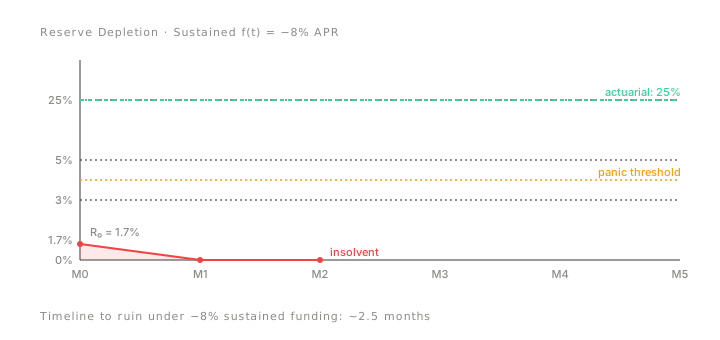
Two and a half months. That's how long the reserve lasts under a funding environment that we know has already happened once.
The protocol doesn't need to encounter some unprecedented catastrophe. It just needs to live through another 2022.
Scenario 2: what if a major exchange fails?
USDe's short positions aren't held on-chain. They're held on centralised exchanges — Bybit, OKX, Binance Futures. This is a practical necessity: the liquidity for these trades lives on CEXs. But it introduces a counterparty risk that doesn't exist in the funding rate math.
In November 2022, FTX collapsed in about three days. It held roughly 10% of the equivalent exposure that USDe-style strategies would have needed. When it went under, positions held there became worthless or inaccessible.
If a similar-sized exchange holds 10% of USDe's shorts today, and that exchange fails during a volatile period when ETH is moving hard:
A 10% exposure with a 50% forced-liquidation move is a $5B loss on a 100B TVL base. Against a {{red:1.7B reserve}}, that's a 3× loss. The reserve is gone before the next block.
This isn't a probability-zero scenario. It's a probability-happened-once-in-the-last-3-years scenario.
Scenario 3: the 30-second crash
Delta-neutral strategies assume that when ETH's spot price moves, the futures price moves with it. In normal markets, they do — the difference between spot and futures (called the basis) stays small and predictable.
But in flash crashes — those moments when ETH drops 5% in 30 seconds on thin liquidity — the two markets can diverge briefly. Spot moves first. Futures lag by milliseconds to seconds. During that gap, the hedge is imperfect.
If ETH drops 2.5% instantly and perps lag, creating a 4% basis divergence on $100B of notional shorts:
Against $1.7B in reserve: insolvent in under a minute. Flash crashes of this magnitude happen several times a year on major venues. It's not exotic — it's Tuesday.
What would an insurance actuary say?
Insurance companies face exactly this problem — they take in premiums and pay out claims, and they need to know how large a cushion to hold to avoid going bankrupt. There's a formal mathematical framework for this called Cramér-Lundberg ruin theory.
The core insight is this: given your income rate, the frequency and size of losses you face, and a target probability of ruin (say, less than 1%), there's a minimum reserve you need to hold. Too little reserve and you'll eventually get wiped out by an unlucky cluster of claims.
For a delta-neutral stablecoin, the math gives us a bound on the ruin probability that looks like this:
This result is derived formally in Martin-Löf & Sköllermo, 'Notes on Risk Theory' (arXiv:1110.2642, Section 3.2.5, p.30–32). The approximation r(u) ≈ Ce^(−Ru) holds asymptotically as u → ∞, where R is the Lundberg exponent — the positive root of g(R) = cR.
Intuition: reserve does not improve safety linearly here. It improves safety exponentially. If the loss process gets heavier-tailed or more frequent, θ (and R) drop, and the reserve required for the same safety target rises quickly.
If we want the ruin probability to be at most 1%, we need a reserve of at least:
Concrete check: if θ = 0.30, then u_min ≈ 15%; if θ = 0.22, u_min ≈ 21%; if θ = 0.18, u_min ≈ 26%; if θ = 0.15, u_min ≈ 31%. That's why small changes in assumptions can move the required reserve a lot.
Mapping plausible funding stress and tail events into this framework gives a wide range: high single digits in routine-only conditions, and high teens to around 30% once tails are included.
| Scenario | λ | μ_X | Annual loss | R_min |
|---|---|---|---|---|
| Routine only | 0.75 | 2% | 1.5% | ~8% |
| Routine + mild tail | 1.0 | 5% | 5% | ~15% |
| Baseline | 1.5 | 8% | 12% | ~22% |
| Conservative | 2.0 | 12% | 24% | ~30% |
| FTX-type tail | 0.2 | 25% | 5% | ~28% |
In this table, λ is loss-event frequency, μ_X is average loss size conditional on an event, annual loss is λ × μ_X, and R_min is the reserve floor for approximately 1% ruin risk.
We use 25% as a conservative working midpoint because it sits above baseline (~22%) and close to stress-tail cases (~28-30%). Ethena's 1.7% sits below even the routine-only floor (~8%).
USDe holds 1.7%. That's roughly 5× to 18× below the modeled scenario range, and about 15× below the 25% midpoint.
To be fair to Ethena: they're not running an insurance company. They're running a yield product. But the math doesn't stop applying just because the business model is different. The reserve is what stands between a bad month and a collapse.
The exit game: what would you do?
Now let's make this personal. Imagine you hold USDe. The market has been falling for two months. Funding rates have been negative. You've seen the reserve ratio drop from 1.7% to 0.7% (based on public data, let's say). The yield on USDe is now negative — you're losing money holding it.
You're in a group chat with other DeFi traders. Someone says they just started redeeming their USDe position.
What do you do?
If you stay, you're betting: (a) the reserve doesn't run out before conditions improve, and (b) nobody else panics before you do. If either of those bets goes wrong, you get back less than a dollar per USDe.
If you leave now, you get your dollar back minus a small slippage fee. Clean exit.
This is the same logic we covered in the Angle piece. In formal terms, staying is worth:
And leaving is worth:
The slippage you face depends on how many other people are trying to exit at the same time. If you're early, slippage is tiny. If you're late, it's high. Which means:
Every rational person in that group chat is running the same calculation. And the rational answer, when the reserve is low and others are leaving, is to leave. Fast.
The reserve falling triggers exits. Exits accelerate the reserve falling. Accelerating reserve decline triggers more exits. This is the same cascade that destroyed Angle. It doesn't require malice or bad luck — just rational people with the wrong incentive structure.
What would actually fix this
There's a simple intervention that breaks the run dynamic: make early exit unavailable during a panic.
Specifically: if more than 5% of TVL tries to exit within a 24-hour window, pause redemptions for 7 days. When the pause is in place:
If exit is unavailable, there's no first-mover advantage. You can't beat anyone to the door because the door is locked for everyone equally. The panic calculus completely changes.
Seven days later, the market may have stabilised. Funding rates may have normalised. The crisis that triggered the panic may have passed. And the cascade that would have wiped the reserve never gets started.
This isn't a novel idea. It's what Diamond and Dybvig recommended in 1983. Banks use versions of it. It just needs to be built into the protocol before the panic hits — retrofitting it during a crisis is too late.
What does the future actually look like?
Let's be honest about the range of outcomes here:
| What happens | Rough odds | How fast would it fail? |
|---|---|---|
| Bear market hits in the next 12 months | ~40% | 2–3 months of negative funding |
| Bear market hits in years 2–3 | ~30% | Reserve builds up, buys more time — still fails eventually |
| A major CEX goes under (FTX-style) | ~20% over 3 years | One block — instant |
| An off-chain system gets compromised (Resolv-style) | ~5–10% per year | One block — instant |
Probability estimates are illustrative order-of-magnitude figures based on historical base rates: ETH has entered 30%+ drawdowns roughly every 18–24 months since 2018; one major CEX failure (FTX) has occurred in the last 4 years of significant delta-neutral market activity. These are not calibrated model outputs.
The most likely single path: USDe has a good run for another 2–3 years while markets are favourable, the reserve slowly grows (Ethena is actively building it), and then a bear market tests whether it's enough. Whether it survives depends almost entirely on how large the reserve is when the bear market arrives.
The honest scorecard
| What protects you | Angle had | USDe has today | What's needed |
|---|---|---|---|
| Reserve buffer | Informal / tiny | 1.7% | ≥ 25% (actuarial) |
| Can't exit during a panic | Nothing | Nothing | Redemption pause + penalty |
| Someone watching for a run | Manual, slow | Real-time data | Automatic circuit breaker |
| First-mover advantage eliminated | Nothing | Nothing | FIFO queues + lockups |
USDe is genuinely better than Angle in almost every technical dimension. The team is more sophisticated. The infrastructure is more robust. The monitoring is real-time instead of manual.
But it shares the one structural weakness that matters most: there is nothing in the design that breaks the bank run game once it starts. And the reserve sitting behind it is 15× below what actuarial math says you need.
None of this means USDe will fail. It means USDe will fail if the right conditions hit before the reserve grows large enough. Angle proved the conditions are real. The numbers here show how little margin USDe currently has when they arrive.
The yield is real today. The question is whether the buffer will be real when the market stops cooperating.